
Aoniyoshi * Nara Diary
〜 From my daily scene of Japanese painting artwork creation 〜
Shizu Kishimoto
I have been living in Nara City, the ancient capital of Japan, painting pictures such as deer in Nara Park, surrounding landscapes, and creatures with traditional Japanese painting (Japanese-style painting) techniques. I also create some kinds of mysterious paintings such as dragon, phoenix and objects including Japanese ancient characters.
What a tree taught me
In the process of creating Japanese paintings, I think the act of “sketching” is that of becoming one with nature — spending many hours with my subjects until I melt into their world. When I am absorbed in facing the objects, nature shows me the true form of “living” beyond the species from each figure such as towering trees, branches swaying in the wind and falling flower petals.
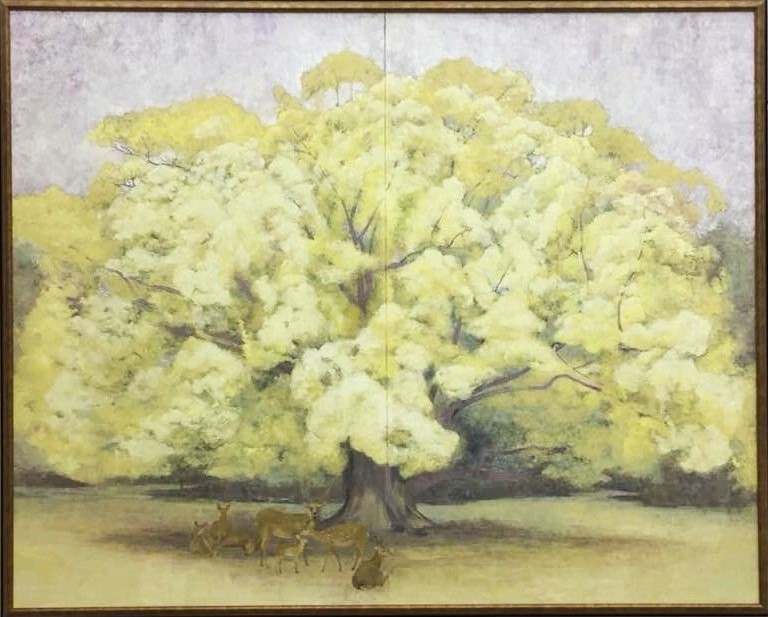
It was when I was sketching a 100-year-old camphor tree. It looked like a big tree, but it actually was made up of three trees with a good balance on both sides, making it look like one big camphor tree. Trees emit ethylene, a type of gas as they grow. As a result, the trees grow in balance with each other.
Also, when I was facing a cherry tree whose leaves fluttered in the wind, the wind was so strong that I was waiting for the wind to stop, looking at the branches that never stop moving. As I looked at them, I began to realize “Because trees flutter without resisting the wind, their branches don’t break. And when the wind dies down, they can easily return to their original shape because they have got their roots firmly in the soil.”.
Reflecting it on myself who has been struggling and not being able to proceed as I wanted every day, I felt as if the trees taught me the wisdom of “How people should know their own vessels and control their own desires, and live their lives.”
The thought I put into my Japanese painting artwork
While sketching in various scenes in nature and making Japanese paintings, I came to the following idea. “The world in which we exist is that of material dimensions. When the objects we face every day change their shapes or existence, or lose themselves, emotions are born and the soul as an author or a human being is nourished. “Living” is a repetition of those things and cultivating a soul with strong will and rich emotions might be the goal and meaning of living.” For me, Japanese paintings is a way to project such thoughts on my artworks.
The materials used in Japanese paintings include the ones used in primitive art around the world. For example, the ores found in natural mineral pigments (Iwa-enogu) include quartz and malachite which have been crystallized over tens of thousands or hundreds of thousands of years in the earth, in other words, a piece of the Earth. I feel the series of work that crushing these ores and draw it fixing them with animal-hide glue (Nikawa) on hemp paper is like an act of drawing up with various layered lives.
I think the fact that the genre of Japanese painting has developed to the present day is deeply related to the climate of Japan that has four seasons and many natural disasters. This “impermanent” natural environment may have nurtured our minds, and so too has the culture of Japanese painting as well. Through the process of losing tangible things and regenerating them, our sensibilities may have been sharpened by feeling their fragility and meanings.
I feel “life” in the art materials themselves, as I mentioned earlier, because the materials for Japanese painting are made of natural materials. Through such background of Japanese painting materials as well, the thought I put into my work is, “I want to create pictures filled with a world full of life energy!”
Also, in this world of the material dimension, what each of us must face at the end is “life”. It’s our own “life”. I guess I will only learn its true significance when I’m about to lose it.
It was a painting of a fox — seen at an exhibition before I started elementary school — that first introduced me to the materials of Japanese painting. I was really fascinated by the glinting Japanese painting materials made from rocks, Iwa-enogu. I still remember vividly that surprise and impression, ‘What is that material ?’ as if I saw it just yesterday.
I want to feel the significance and fragility of “lives” by encountering them in various forms and witnessing its passing, then express this great theme through my own filter, Japanese painting.
* Aoniyoshi – is one of Makura-kotoba, a kind of prefix used in ancient Japanese writings, it always comes directly prior to the word “Nara”.

